In speculative fiction, timberpunk—or lumberpunk—envisions an alternate future sustained almost entirely by the mechanics and technologies of wood. Like cyberpunk or solarpunk, the “-punk” suffix carries a DIY spirit, rooted in handcraft and self-making. It resists the logic of mass consumption. From this speculative terrain, Zulfian Amrullah presents Timber Punk: Streams of Banished Kin.1 In doing so, he enters into a new pact with wood waste.
Zulfian is not trying to prototype a wood-based technology. Nor does he seem to be imagining another future altogether. The future, which increasingly feels dystopian rather than hopeful, is already here: the floods and landslides that struck Sumatra at the end of November 2025 not only claimed thousands of lives and displaced hundreds of thousands more, but also swept away thousands of logs that later damaged settlements in Aceh, North Sumatra, and West Sumatra. However much official narratives may insist that the disaster was simply the result of Cyclone Senyar, those wrecked logs stand as plain evidence of large-scale deforestation in Sumatra, driven by the opening of land for palm oil, mining, and other extractive, forest-based industries operating beyond their concessions.2
For many people, especially Indigenous communities, trees are sacred. A tree is not merely a leafy organism that produces oxygen and absorbs carbon dioxide, only to be recast as a state asset; it is an active presence, bound to its community through emotional, spiritual, and cultural ties. When a tree is cut, it is done with honor, after ritual observance, and what remains is guarded through strict systems of customary zoning and law. In Yogyakarta’s Alun-Alun, for instance, one finds a pair of banyan trees that are fenced in, named, and treated as keraton heirlooms.
Timber Punk: Streams of Banished Kin is Zulfian’s way of reflecting on wood waste within an art world shaped by all these concerns around wood, trees, and forests—an art world shadowed by dispossession, erasure, and disaster. What industrial society treats as the final stage in a tree’s life cycle becomes, in Zulfian’s hands, the starting point of creation.
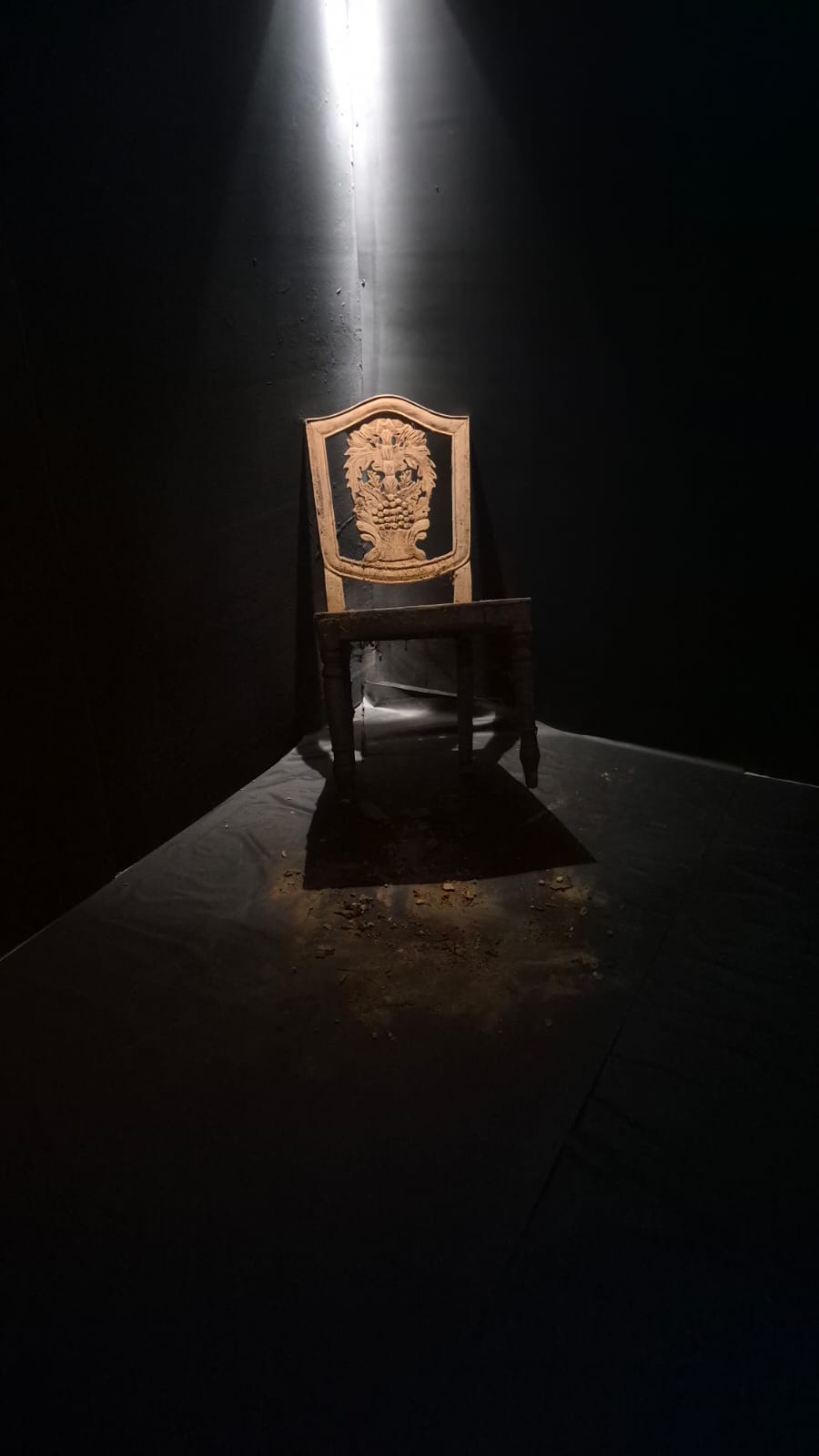
He is an artist long known for thinking through the body and human relations by shaping objects, especially chairs. In his work, a chair becomes an anatomy capable of acting out human qualities and scenes: eating, gathering, conversing, praying in contemplation. His 2024 solo exhibition, Performa Kinestetik,3 brought together a range of anthropomorphic gestures and scenes in a single atmosphere. Beyond presenting isolated figures or small groups, Performa Kinestetik tested the acrobatic, theatrical, and architectural possibilities of chairs and wood. It proposed a new narrative of the body, as works that had previously existed in separate environments moved together in one unfolding act. In one design from that exhibition, a line of long, slender-legged chairs marched forward in formation, joining hands with several ordinary chairs that appeared to have fallen over; the arrangement reads almost as a precursor to Timber Punk: Streams of Banished Kin.
What is magical about Zulfian’s work is how easily it receives our emotions. Perhaps this is because his pieces appear without faces, stripped of any obvious expression. They become empty vessels onto which viewers can project feeling. I once met a visitor to Performa Kinestetik who stood alone, eyes wet with tears, after looking at a cluster of chairs with rusted iron frames surrounding a single chair whose slack backrest had been bound with loose rope. She then poured out her experience to me, deeply moved. That encounter is one small sign of Zulfian’s powerful sense of staging, shaped in part by his work as a performance set designer. And yet, to a certain extent, as he may himself recognize, his works have often risked becoming too explicit, too illustrative; their compositions can be overly governed by intention. Timber Punk: Streams of Banished Kin marks his step beyond that tendency. He turns instead to scraps of mahogany and teak from workshops and sawmills in Yogyakarta—a furniture city that, ironically, relies on timber supplied by several regencies in Central and East Java. He builds from what has been cast aside.
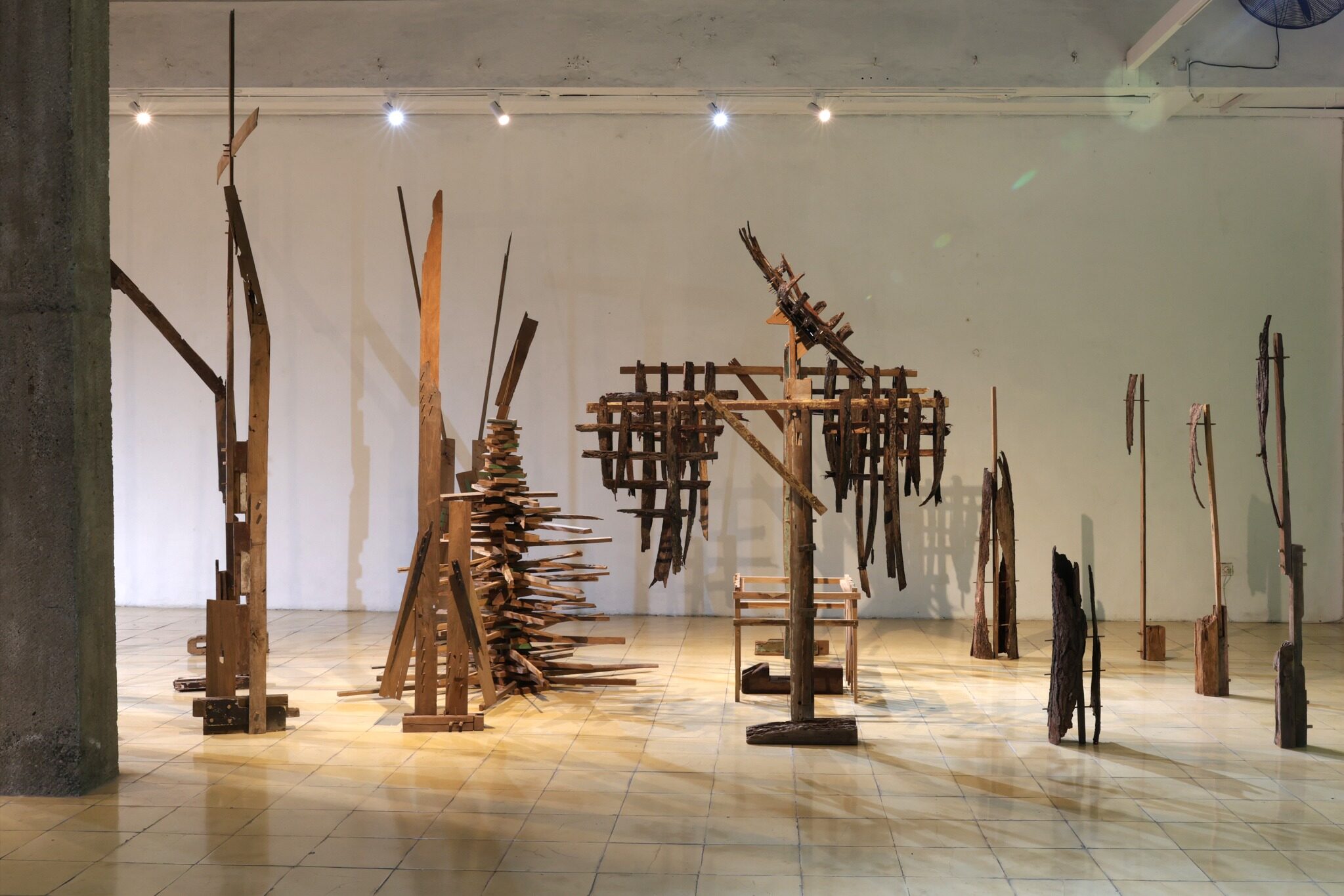
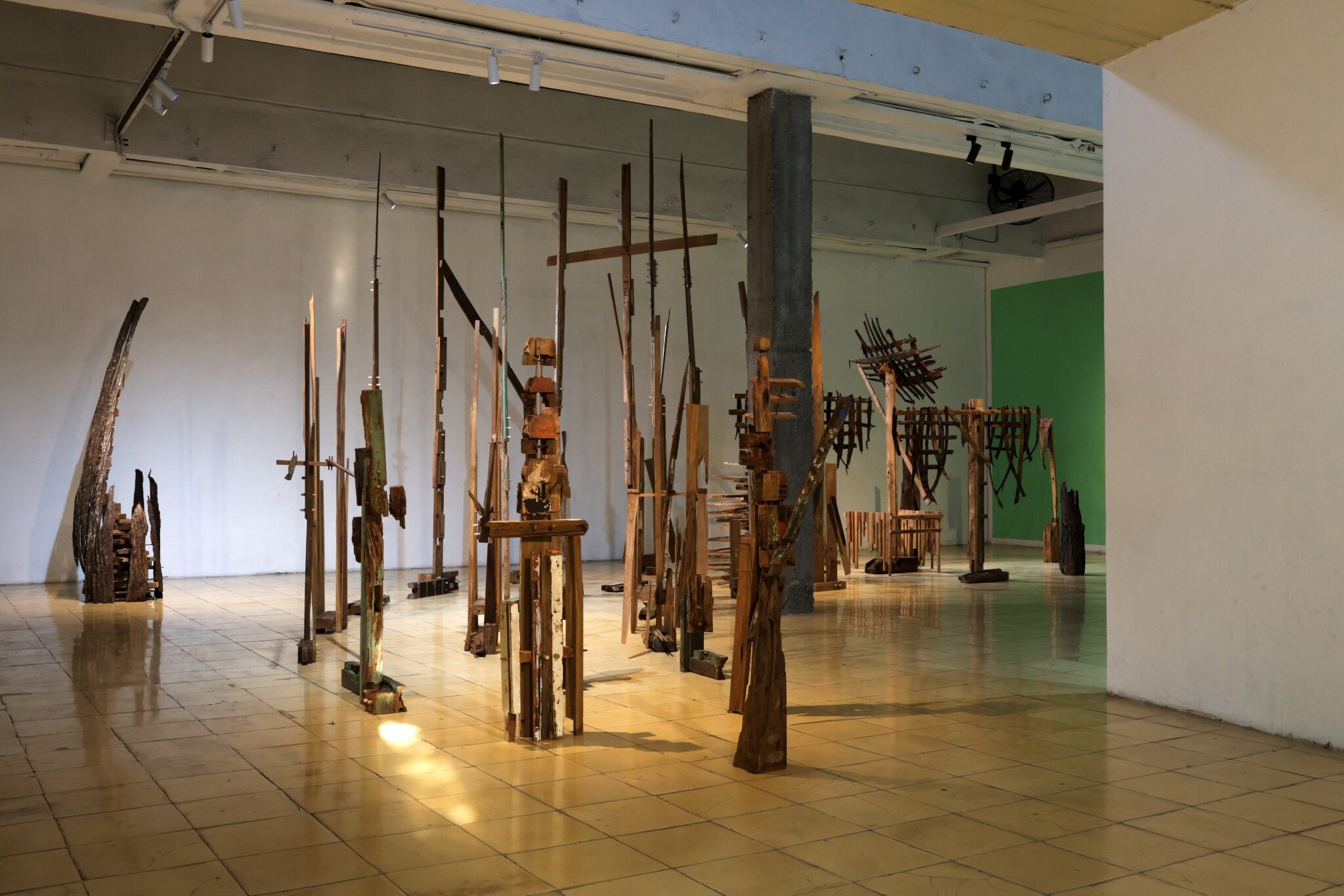
While preparing the installation, Zulfian found himself thinking of parade formations after witnessing the Grebeg Syawal ceremony during his residency.4 He abstracted that image into an arrangement of timber offcuts, found wood, and bark, assembling them into a procession of poles that moves from the center of Cemeti’s gallery toward one corner, leaving space for visitors to walk among them. This procession of wood waste passes a concrete pillar in the middle of the room, setting the two materials side by side as industrial substances. If Grebeg Syawal accompanies the gunungan—a mountain of produce and food, often fought over by the crowd during the procession—this work gives body to rejected remains, to factory rejects that fail to meet the strict standards of industry, however slight the flaw may be. Zulfian himself chooses the harsher word “banished”: wood eaten by termites, or wood that once served as a foundation keeping people safe while they slept, now seems unwanted and barred from return. It has nowhere to go back to. In the end, these remnants form a kinship of their own: the banished kin.
Timber Punk: Streams of Banished Kin was not made without planning, but it was designed directly on site. Zulfian speaks of “thinking through making,” though here he was less making than repurposing what had already been made. Or perhaps: thinking through material. This presentation is more direct than Performa Kinestetik. Its process is more improvisational, yet still shaped by structural testing and practical calculation. The standing, marching forms of the poles answer directly to industrial habits that pile wood into uniform pieces and leave it lying in standardized form. Zulfian turns the natural qualities of these rough, fragile, unpredictable offcuts and bark into possibilities for form and composition. In this, one might recall the sculptor Anusapati, whose work at one stage minimized sculptural intervention and instead foregrounded the natural character of wood or trees, as in Summer-Autumn-Winter (1997), or in his most recent large-scale installation of dead trees, Secret of Eden (2025).5 If Anusapati reduces intervention as an act of respect toward nature, Zulfian works with its remnants, arranging them not as an imitation of a whole tree, but as a new kinship. Anusapati mourns a lost Eden, while Zulfian builds a community of survivors from the wreckage.
Timber Punk: Streams of Banished Kin is a quiet parade, a moment of silence for those cast out of the industrial chain of production. The installation marks a shift in Zulfian’s practice as he reconsiders his artistic stance and method, while bringing an ecological ethic into the balance. It challenges him to work directly with the waste before him and to set aside, at least for the time being, his usual desire for precision in construction.
- Timber Punk: Streams of Banished Kin was the result of Zulfian Amrullah’s residency at Cemeti - Institute for Art and Society, which ran for three months from March to May 2026. The exhibition marked the first time Zulfian worked entirely with wood waste.
- Mongabay Indonesia, “Ketika Puluhan Perusahaan Kena Sanksi Kasus Banjir Sumatera, Bagaimana Pemulihan?” Mongabay.co.id, 24 April 2026, mongabay.co.id ↗
- Performa Kinestetik was Zulfian Amrullah’s solo exhibition at Komunitas Salihara Arts Center in South Jakarta, held from 20 to 30 April 2024 as part of Road to ARTJOG 2024.
- Grebeg is a Javanese ceremonial tradition in which the palace presents offerings to the public as a sign of gratitude for nature’s abundance and a prayer for protection. The procession features palace guards escorting a gunungan from the palace to the North Square, ending at the courtyard of the Gedhe Kauman Mosque; its main forms include Grebeg Syawal, Grebeg Besar, and Grebeg Maulud.
- See further in Nurdian Ichsan, Pohon/Kayu: Monografi Anusapati (Jakarta: Gang Kabel, 2025).